Browser automation · No code
Connect your AI agent to your web browser.
Describe the job once, in plain language, and the agent drives a real browser to do it — regression tests that never needed a selector, and the weekly click-through you keep putting off. Every step on screen, in your own window.
macOS 12 or later · Apple Silicon or Intel · 223 MB · Free, no account · Runs entirely on your machine
Also available for Windows — download Wysebee-0.4.0-setup.exe (179 MB)
What people use it for
Two jobs. Same browser.
Neither needs code.
Every browser task is the same shape underneath: open something, read it, click the right thing, and know whether it worked.
Tests that survive a redesign.
Write the run-through the way you'd hand it to a new QA hire — open this, sign in, check the total is right. There is no selector to update when a class name changes, because you never wrote one. The agent reads the page the way a person does and finds the thing you described.
- No selectors, no waits, no page objects to maintain
- Runs against the real browser, so what passes is what a user gets
- Watch each step as it runs, and stop it the moment it goes wrong
- Keep the run-through as a skill and start it again whenever you ship
- Finishes with screenshots, a recording, and a Playwright spec you can commit
The flows nobody automated because the setup cost more than doing it by hand.
The click-through you keep putting off.
The portal with no API. The report somebody has to export every Monday. The form that takes forty seconds and gets filled in two hundred times. You describe it once and then stop doing it — and because it drives your own logged-in browser, there is no integration to request and no credentials to hand over to anyone.
- Works on sites that never published an API
- Uses the session you're already signed into
- Pulls out an answer, not a page of links
- Nothing is handed to a third party to do it for you
If you can describe it to a colleague, you can hand it over.
A real run · automation testing

“Explore the flow of sign
in, find product, purchase.”
One sentence — no selectors, no fixtures, no page objects. The agent signed in, searched the catalogue, opened the product, filled the checkout and landed on the confirmation. Then it handed back the evidence.
You write
“Check that sign-in, finding a product and checkout still work.”
Plain language. No selectors, no fixtures, no script.
Wysebee

Drives your real browser
It opens the pages, clicks, reads and fills — on screen, step by step, in the browser you already use.
You get
- Screenshotsone per step
- Recordingthe whole run, as video
- Playwright specready to commit
When it finishes, you get the evidence.
Not just a pass or a fail. Every run leaves behind what you would otherwise have to capture by hand.
- Step screenshots
One frame per action, numbered in order, so a failure has a picture attached.
- RecordingThe good part
The whole run as an animated WebP or GIF — droppable straight into a ticket.
- Playwright sourceThe good part
A test file for the steps it just took, ready to run in the suite you already have.
Including the test itself.
The exploratory run becomes a Playwright spec for the steps it actually took — so the thing you described in a sentence ends up in version control, running on every commit like any other test.
import { test, expect } from '@playwright/test';

test('sign in, find product, purchase', async ({ page }) => {
  await page.goto('/login');
  await page.getByLabel('Email').fill('demo@example.com');
  await page.getByLabel('Password').fill('demo');
  await page.getByRole('button', { name: 'Sign in' }).click();

  await page.getByRole('link', { name: 'Electronics' }).click();
  await page.getByRole('link', {
    name: 'Noise-Cancelling Headphones',
  }).click();
  await page.getByRole('button', { name: 'Add to cart' }).click();

  await page.getByRole('link', { name: /Cart/ }).click();
  await page.getByRole('button', { name: /Pay \$199\.99/ }).click();

  await expect(
    page.getByText('Thanks for your order!'),
  ).toBeVisible();
});
Illustrative of the captured steps — your generated file will match your own markup.
A real run · personal productivity
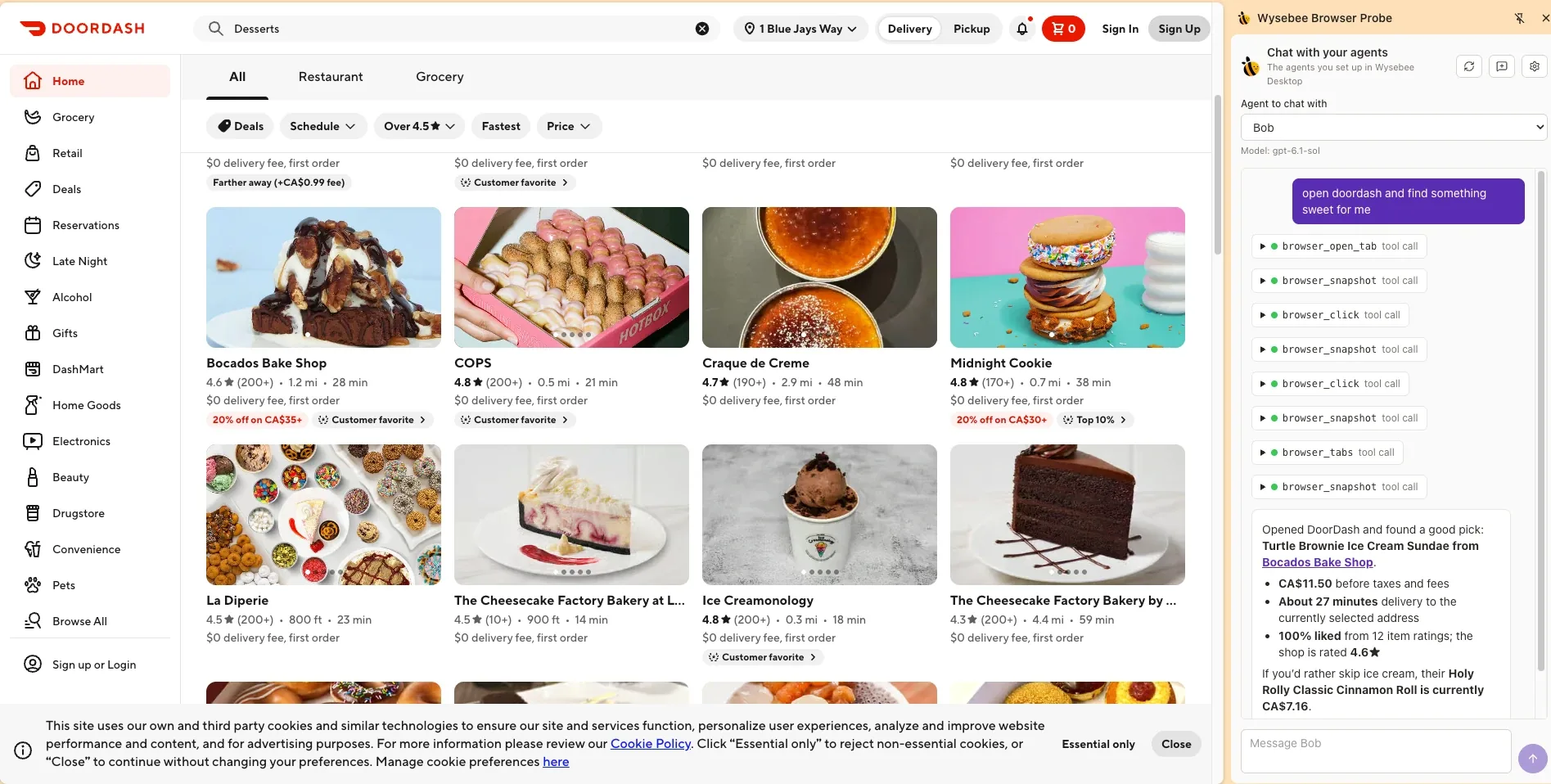
“Find me something
sweet nearby.”
One sentence, no code, and no API key for a food-delivery site that never offered one. Watch the left half of the window: that is your own browser being driven, live, while the agent narrates every call on the right.
What it came back with
Turtle Brownie Ice Cream Sundae — Bocados Bake Shop
- CA$11.50 before taxes and fees
- ~27 minutes to the selected address
- 100% liked over 12 ratings · shop 4.6★
Plus a fallback it offered unprompted: the Holy Rolly Classic Cinnamon Roll at CA$7.16, in case you'd rather skip ice cream.
Your browser, not a datacenter's
A browser extension drives the real tab on the left — on screen, on your machine, in the session you are already signed into. No headless browser somewhere you can't see, no scraping farm.
No API needed
DoorDash publishes nothing for this. The agent did not need it to: it read the page, clicked through and filtered the same way you would.
Eight calls, all on the transcript
browser_open_tab, snapshot, click, snapshot, click, snapshot, tabs, snapshot — each one listed as it happened, each one openable to see what went in and what came back.
Getting started
Two installs, one key,
and you're running.
There is no project to set up and nothing to wire together. The longest part is waiting for the download.
- 01
Install the app, then the extension
Download Wysebee Desktop and follow the prompt to add the browser extension. That extension is the whole trick: it lets the agent drive the browser you already use, with the tabs and the sessions you already have open.
Two installs, no configuration
- 02
Add a model key
Paste a key from whichever provider you already pay for — or point it at a model running on your own machine through Ollama or LM Studio and skip the key entirely.
One field
- 03
Good to go
That is the setup. Ask for what you want in plain language and watch it work in your own window — no project to scaffold, no selectors to write, nothing to deploy.
Just ask
Teach it a site, once
For a site you use constantly or a run-through you repeat, write a skill — the steps in plain language, saved. The agent loads it when that job comes round, so you explain the quirks of your admin panel once instead of every session. You never need one to get started.
Under your eye
An agent with real hands
needs real limits.
An agent driving the browser you are signed into is the part that should make you nervous. Four things are built for exactly that worry, and none of them is something you have to switch on.
You watch the work happen.
The agent does not disappear and come back with a result. Every action is on screen as it takes it — the page it opened, the button it clicked, the field it filled — so a wrong turn is something you catch in the moment, not something you discover afterwards.
- Each step surfaced as it happens, not summarised at the end
- Stop it mid-run; nothing is a black box you cannot interrupt
- The skill you wrote is the instruction set — no hidden prompt
It asks before it acts.
You decide site by site. Approve or deny what the agent may do on a particular website — or, on a test site where nothing is precious, allow everything and let a run go through uninterrupted.
- Accept or deny operations on any specific website
- Allow all operations on a test site, so runs don't stall on prompts
- A decision you make per site, not a blanket grant up front
The model key never leaves the app.
Your provider key is held by the desktop app on your own machine. It is never handed to a page the agent visits and never handed to the browser extension — so no site it opens can read it, and nothing in the browser can leak it.
- Encrypted at rest on your own machine
- Never exposed to the web page or to the extension
- Never shown again in the UI once saved
Screenshots stay on your disk.
The screenshots and recordings a run captures are written as ordinary files on your own machine. There is no upload step, and no bucket somewhere holding pictures of your admin panel.
- Screenshots and recordings saved as local files
- Sensitive captures are never uploaded anywhere
- Delete the folder and the evidence is gone
Any provider
Bring your own model.
Or don't bring one at all.
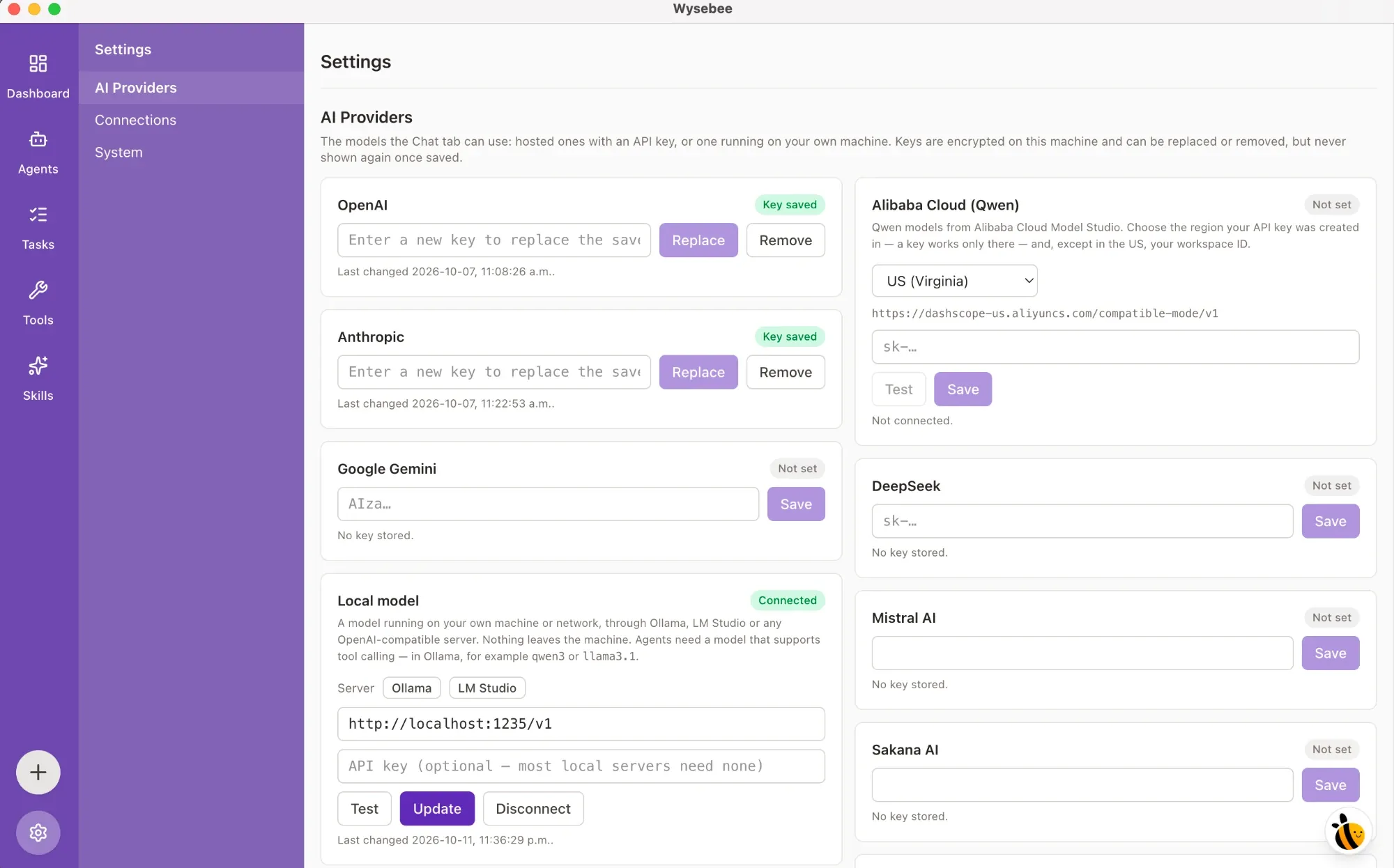
Paste a key from whichever provider you already pay for — or point Wysebee at a model running on your own machine and skip the key entirely. Same agent, same tools, same screen; only the brain changes.
Hosted, with a key
- OpenAI
- Anthropic
- Google Gemini
- Alibaba Cloud (Qwen)
- DeepSeek
- Mistral AI
- Sakana AI
Keys are encrypted on this machine. They can be replaced or removed, but are never shown again once saved — not in the UI, and not to the agent.
Local, with no key
Ollama · LM Studio
Or any OpenAI-compatible server on your machine or your network. Point Wysebee at the URL, leave the key blank, and nothing leaves the machine — not the prompt, not the page the agent read, not the rows it queried.
Pick a model that supports tool calling — in Ollama, qwen3 or llama3.1.
It runs on your machine.
Wysebee Desktop turns your computer into a set of nodes — named bundles of tools you build by filling in a form — and gives your agent exactly those, and nothing else. The work happens where you can see it, on hardware you own.
macOS 12 or later · Apple Silicon or Intel · 223 MB · Free forever · No telemetry
Also available for Windows — download Wysebee-0.4.0-setup.exe (179 MB)
No sign-in, no account
Install the app, add the browser extension it points you to, paste a model key. Nothing dials out and there is nothing to sign up for.
No code, anywhere
No SDK to learn, no server to write, no selectors to maintain, and no deploy step between you and a working agent.
Skills, when you want them
Optional: write a run-through once for a site you use constantly, and the agent loads it when that job comes round instead of you re-explaining it.
Everything stays local
Settings, skills, and every screenshot a run captures are files on your own disk. Delete them and nothing is left.
FAQ
Questions we get asked
What does Wysebee actually do?
It connects an AI agent to your web browser and runs it while you watch. You say which sites it may use and write the run-through in plain language; the agent then opens the pages, clicks, reads and fills in forms to get the job done. People use it for two things above all: browser tests that need no selectors, and the repetitive click-through nobody wants to keep doing by hand.
How do I get set up?
Three steps. Install Wysebee Desktop and follow the prompt to add the browser extension — that extension is what lets the agent drive the browser you already use. Then add a model key, either from a hosted provider or a local model running through Ollama or LM Studio. Then you are done: ask for what you want in plain language. There is no project to scaffold and nothing to deploy.
Do I need to know how to code?
No, and you do not need to know CSS selectors or XPath either. You describe the run-through the way you would explain it to a colleague — open this page, sign in, check the total — and the agent works out what to click. There is no SDK to learn, no test framework to set up and no deploy step.
What do I get when a test run finishes?
The evidence, not just a pass or a fail. Every run leaves numbered step screenshots — one per action — plus a recording of the whole thing as an animated WebP or GIF you can drop straight into a ticket. It also generates Playwright test source code for the steps it captured, so an exploratory run you described in one sentence ends up as a committed test running on every build.
Can I see what the agent is doing?
That is the point. Every action is surfaced as it happens — the page it opened, the command it ran, the change it made — rather than summarised after the fact. You can stop a run in the middle. The skill you wrote is the instruction set, so there is no hidden prompt deciding things on your behalf.
Can the agent read or write files on my computer?
What a run captures — screenshots and recordings — is written as ordinary files on your own machine, and nothing is uploaded. The agent works through the browser, so what it can reach is what the browser can reach, and you approve or deny its operations per website.
Does it only work with the browser?
The browser is what Wysebee is built around and what it is best at, so that is what this page is about. The desktop app can also call HTTP APIs you configure, which is useful when a browser job needs to fetch something directly. If you came here for the browser, you can ignore that.
What is a skill, and do I need one?
You do not need one to start. A skill is a written run-through for a site you use constantly or a job you repeat — the steps in plain language, saved once. The agent loads it when that job comes round, so you explain the quirks of your admin panel a single time instead of every session. Plenty of people never write one and just ask for things as they go.
Which AI model does it use?
Whichever you point it at. Paste a key for OpenAI, Anthropic, Google Gemini, Alibaba Cloud (Qwen), DeepSeek, Mistral AI or Sakana AI — keys are encrypted on your machine and never shown again once saved. Or run the model yourself through Ollama, LM Studio or any OpenAI-compatible server, leave the key blank, and nothing leaves the machine at all. Pick a model that supports tool calling; in Ollama, qwen3 and llama3.1 both do.
Is it really free?
Yes. Wysebee Desktop is free to download and use, with no account, no sign-in, and no telemetry. Everything runs on your own machine.
Which platforms does it support?
macOS 12 or later on Apple Silicon or Intel, and Windows 10 or later on 64-bit. The Mac build is Developer ID signed and notarized by Apple, so it opens with no Gatekeeper warning. The Windows installer, app and uninstaller are Authenticode-signed with an EV certificate and timestamped, so Windows names Wysebee Inc. as the publisher instead of warning about an unknown one — and it installs for your user only, with no administrator prompt. A Linux build is not available yet.
Where does my data go?
Nowhere. Everything durable — settings, skills, and the screenshots and recordings a run captures — lives in files on your own machine. There is no sign-in, nothing dials out, and your model key is never handed to a web page or to the extension.
How do I get help?
Join the Discord. That is where questions get answered, rough edges get reported, and what ships next gets decided. Bugs and feature requests for the desktop app can also go to the GitHub issue tracker.
Come build with us.
No forms, no pitch deck, no sales call. The Discord is where the questions get answered, the rough edges get reported, and what ships next gets decided.
Free, no account required. Download and run it in minutes.